The Slavs settled in the area of Poland and western Russia about 1500bc. The Vikings traded in Russia during the 9th century ad, which was made easy with the extensive river waterways. The area near Lake Ilmen was a popular trade center, including the city
Novgorod in which settlements date to the middle of the 9th century. The viking tribes of this area were know as the
Rus which may be the origin of the name Russia. In 882 a Viking leader named Oleg siezed the town of Kiev and in 911 established a treaty with the Byzantine empire. Vladimir, a Viking ruler in Kiev, was proclaimed prince of Russia in 980 and then in 988 he chose Greek Orthodox as the religion of Russia.
The region was invaded by the Mongols in 1237 to 1395. They were known as the Golden Horde or Tatars. Ivan III ended the independence of Novogorod and in 1480 refused to pay taxes to the Golden Horde, ending their power. Ivan the IV, known as Ivan the Terrible, took power at 16 in 1547. He married Anastasia. After Ivan the Terrible, there were two men who claimed to be Dmitri, heir of the throne, and eventually Michael Romanov, great-nephew of Anastasia, was elected as tsar in 1613, the beginning of the Romanov dynasty.
Vitus Bering was a Danish navigator that served in the Russian navy during the Swedish war. Under the plan of Peter the Great, in 1741 he led an expedition toward America and landed at Kayak Island and discovered some of the Aleutian Islands.
After the death of Alexis in 1676 the families struggled and Peter, son by this second wife Natalia, was a co-tsar until 1696 when his brother Ivan V died. The town of St Petersburg was first established in 1703 and named after him. In 1703 he became the lover of a Lithuanian peasant and when their first child was born, whe was received in the Russian Orthodox church under the name of Catherine. When he was divorced from his first wife, he married her in 1712 and she was crowned empress in 1724. The next 70 years, Russia was ruled by empresses. Catherine I was followed by Anna, daughter of Ivan V; Elizabeth, daughter of Peter and Catherine I; and Catherine the Great.
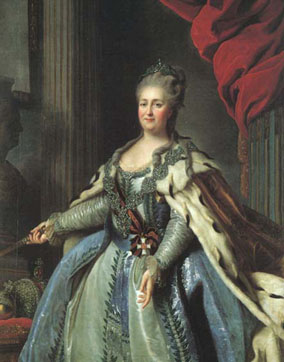
Catherine the Great was a German princess who acquired the throne in 1762 from her husband Peter III after his short rule of 6 months and ruled until her death in 1796. She is followed by her son Paul I and then his son Alexander I. After struggles with Napoleon's army, Alexander I and Napoleon meet on 25 June 1807 near Tilsit, in an elegant room built in the middle of a river border between the lands. After the death of Alexander I in 1825, the first revolution began. Eventually Nicholas I rules until 1855 when Alexander II succeeded his father.
Radicals Lenin and Trotsky emerged in the late 1800s and were exiled. In 1903 the
Russian Social-Democrat Workers' Party assembled. By 1917 when the imperial regime is ended, there was disagreement between Bolsheviks who agreed with Lenin and the Mensheviks who were the minority. Lenin took power and in 1918 moved the seat from Petrograd to Moscow. The Bolshevik name was changed to the Russian Communist Party. Trotsky was put in charge of building the Red Army. When Lenin died in 1924, he was replaced by
Joseph Stalin, who had been appointed Commissar of Nationalities by Lenin.
Stalin died in 1953 and was succeeded by Nikita Khrushchev who led the country until 1964. Brezhnev then led the Soviet Union until 1982. Yuri Andropov formerly the director of the KGB was the General Secretary of the Communist Party of the Soviet Union from 1982 to 1984. Chernenko led from 1984 till 1985.
Mikhail Gorbachev was elected in 1985 and led the Soviet Union through the final years of the
Cold War until 1991.
Visit
The Cold War Museum in Vint Hill, VA. It was founded by Francis Gary Powers, Jr, son of Francis Gary Powers, a CIA pilot whose spy plane was shot down over the Soviet Union in 1960 and he was held for two years until he was traded. The museum currently has mobile and online exhibits. Its permenent location will
open in 2011.
Also visit the
National Cold War Exhibition at the RAF Museum. There is a virtual tour and education activities on the website. See photos of the museum and contents on the
architect's website.
Learn about the
Space Race with Russia on
this website and
from the Smithsonian exhibit. Sputnik was launched and the first animal was sent in orbit by the USSR in 1957. The first man in space was Yuri Gagarin in 1961. The first moon landing was by Apollo 11 in 1969. Today there is more
cooperation between the US and Russia in space as there is talk about further exploration beyond the international space station.
Leaders Since the Cold War
Boris Yeltsin 1991-1996
Viktor Chernomyrdin 1996-1996 (for 1 day)
Boris Yeltsin 1996-1999
Vladimir Putin 1999-2008
Dmitry Medvedev 2008-present (end of term 2012)




No comments:
Post a Comment