Visit the city portal for Velikiy Novgorod to learn more about the rich architectural and artistic history which dates to the middle of the 9th century.
There are several wooden architectural sites on Kizhi Island which is located at the end of Lake Onega near St Petersburg and Petrozabodsk. In 1960 an open-air museum was established to help preserve the wooden architecture of the island. Many were built in the 1300s and are deteriorating.
Assumption Cathedral in Moscow was completed in 1479 under the reign of Ivan III and was designed by Italian architect Aristotle Fioravanti with a combination of traditional Russian Orthodox techniques and Italian Renaissance ideas.
St. Basil's Cathedral in Moscow, also known as the Cathedral of the Protection of the Mother of God, was completed in 1554 and was built by Ivan the Terrible to celbrate the Russian victory over the Tatars at Kazan. Some historians believe that Ivan the Terrible had the architects blinded so that they could not design another building as beautiful! It is an example of Russo-Byzantine traditions, while later works were more influenced by European styles. Napoleon ordered that the cathedral be destroyed, but the order was not carried out.
The Church of the Transfiguration on Kizhi Island built in 1714 has 22 aspen-shinlged onion domes. It is in danger of deterioration.
Smolny Cathedral in St. Petersburg, like the Hermitage, was designed by the Italian architect Rastrelli, who designed many palaces and cathedrals in Russia, Latvia, and Ukraine. Designed in the Rococo style (a French Baroque fashion) and construction was stopped in 1764 and the bell-tower was never built. It was designed for Elisabeth, daughter of Peter the Great, because she wanted to become a nun. When she was given the chance to become empress, she no longer wanted to be a nun.
The Hermitage Winter Palace in St. Petersburg was created for Elisabeth, daughter of Peter the Great. Full of Rococo ornamentation, it was designed by architect Rastrelli and completed in 1762 and is the most famous building of imperial St. Petersburg. It is now a museum that houses many works of antiquities and modern times. Some notable works in the vast collection include Canova's first version of the Three Graces, the Raphael Loggias which is a replica of the orginal in the Vatican, the Gonzaga Cameo from Hellenistic Rome, the Imperial Throne, and an Imperial Carriage.
The neoclassical Tavrichesky Palace in St. Petersburg was designed for Catherine the Great by I. E. Starov using themes from ancient Greece and Rome. It was completed in 1789 and was reconstructed in the early 1900s. It is now the headquarters for the InterParliamentary Assembly of the Commonwealth of Independent States.
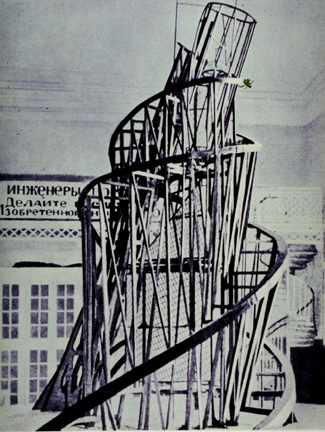
Constructivism was a movement which originated in Moscow in 1917. Influenced by cubism and futurism, it was mainly seen in sculpture but also architecture. The monument to the Third International in Moscow by VladimirTatlin is the most well-known example. Notable architectural examples include Zuyev Workers Club (1929) by Golosov, Melnikov House (1927-29) by Konstantin Melnikov, and Rusakov Workers Club (1927-28) by Konstantin Melnikov. See housing.com for more extensive examples and information.
Lenin's Mausoleum in Moscow was designed by Alexei Shchusev and built in 1924-1930. It was built in the Constructivist movement and its red granite symbolizes Communism and the black labradorite symbolizes mourning.
The Vysotniye Zdaniye, or High Buildings, in Moscow is a series of Neo-Gothic skyscrapers built in the 1950s under a plan by Stalin. The Saviour Cathedral was demolished to make way for the Palace of Soviets, which was to be the tallest building in the world and topped with a 100-meter statue of Lenin, but it was abandoned. The seven tiered towers include the Ministry of Foreign Affairs, the Hotel Ukraine, the Moscow State University Tower, Kotelnicheskaya Naberezhnaya, Kudrinskaya Square, Leningradskaya Hotel, and Red Gate Square. See the photo tour.

We love to travel, but have discovered that travelling with children has "complicated" things. Here we share ideas for travelling as a family to fun places in the US and we pretend to "travel" to places around the world in order to continue experiencing new cultures. Please COMMENT about favorite your experiences while visiting these places. Bon voyage!


No comments:
Post a Comment